 NO KYC CASINO
How Provably Fair Gambling Works: The Cryptography Behind It
Provably fair gambling applies cryptographic verification to game outcomes. The player can mathematically confirm fairness without trusting the operator. This is a closed system where every component is verifiable.
- logged
- by
- Omar Haddad
- rail
- Crypto Gambling
- read
- 4 min
- hash
- 1bb58a3
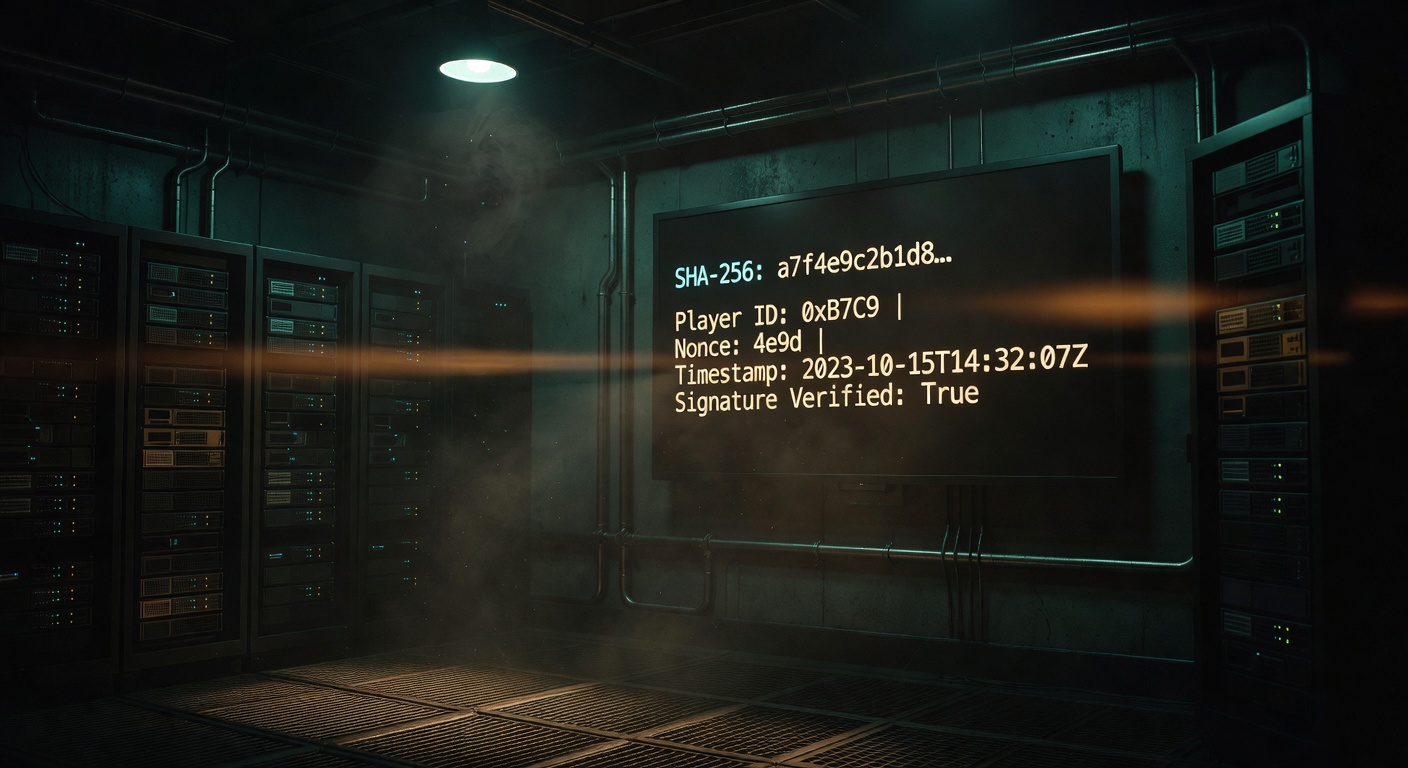
Provably fair systems address a fundamental question: how can a participant verify that an internet game is honestly randomised when the operator monopolises both the randomness source and the outcome presentation?
Historically, the solution was licensing and auditing. Regulators like the Malta Gaming Authority or UK Gambling Commission examine the operator's infrastructure, evaluate their random number generator, and validate compliance. Players rely on the regulator's assessment rather than conducting independent checks.
Provably fair systems reverse this approach. A participant can perform their own verification without depending on a trusted intermediary. Mathematics handles the verification task through cryptographic protocols.
How It Works: The Basic Structure
First, the operator generates a large random value called a seed. They hash it using SHA-256 or a similar cryptographic function, producing a fixed-length string. They post this hash publicly before the game begins. The player cannot reverse-engineer the original seed from the hash. That is the mathematical property of cryptographic hashing.
Second, the game runs. The player makes bets, receives results. The results appear to be random, but they are determined by combining the operator's secret seed with some value the player controls. Usually this is a random number the player generates themselves, or the current block hash from a blockchain.
Third, after the game concludes, the operator reveals the original seed. The player takes that seed, runs it through the same hash function, and confirms it matches the hash the operator posted beforehand. This proves the operator did not invent the seed after seeing the outcome. They committed to it in advance.
If the hash matches, the player can combine the seed with their own random input and recalculate the game outcome. If their calculation produces the same result the operator showed them, the game was fair.
The Nonce and Client Seed
The most common implementation uses two sources of randomness working together. The operator provides the seed. The player provides a client seed, usually a random string they generate in their browser.
The game combines both values. Neither party alone determines the outcome. Even if the operator knows their own seed perfectly, they cannot predict what the player's client seed will be. And even if the player knows their own seed, they cannot know the operator's seed until after the game ends.
This creates a setup where both parties have to cooperate honestly for a specific outcome to occur. If the operator wanted to rig the result, they would have to know the player's input before committing to their own seed. That is cryptographically impossible when hashing is involved.
Nonce as a Variant
Some systems use a different approach: a nonce. The nonce is a counter that increments with each bet. The combination of seed plus nonce produces a different random value for each game. This prevents the operator from reusing the same seed to generate multiple consecutive outcomes.
The player can verify the nonce sequence. If a nonce skips from 5 to 10, the operator has discarded five game outcomes. That is technically allowed by the mathematics, but it signals potential manipulation. A clean provably fair implementation should not have unexplained gaps in nonce sequence.
The Limitations
Provably fair systems verify the randomness of individual outcomes. They do not verify the house edge. A game can be perfectly fairly randomised and still have a house edge of 20%, 5%, or 0.5%. The fairness of the mathematics is separate from the fairness of the payout structure.
Provably fair also assumes the player understands the verification process well enough to execute it correctly. Most players do not. They need software to do it. That software could be compromised. If the verification tool is malicious, the player might be handed false confirmation.
The system also depends on the player actually performing verification. Most do not. They see the checkbox stating the game is provably fair and proceed without checking anything. The cryptographic verification is available but unused.
Blockchain-Based Alternatives
Several platforms employ blockchain hashes as the foundation for randomness generation instead of operator-created seeds. A Bitcoin block hash at a particular timestamp becomes the randomness substrate. Neither the operator nor the participant can forecast or alter what that hash will be.
This introduces a third-party stratum of randomness beyond both parties' influence. The constraint is that the game conclusion gets determined by the block mining schedule, which creates delay. Participants cannot obtain instant results; they must wait for the blockchain to generate a new block.
Blockchain-based provably fair provides superior cryptographic security yet operates more gradually. Operator-hosted provably fair executes quicker but demands that the operator genuinely commit to their seed before the game result materializes.
The Practical Reality
Provably fair is a real technical innovation that genuinely allows verification. A player with the tools and knowledge can confirm fairness mathematically. But it does not eliminate operator advantage, it does not prevent designing games with high house edges, and it depends on players actually performing verification.
For most players, provably fair is a signal of operator sophistication rather than a practical mechanism they use. It is credible evidence that the operator is willing to submit to mathematical verification. That is valuable. It is not equivalent to the player actually verifying anything themselves.