 NO KYC CASINO
Solvers and GTO: A Practical Guide for Modern Poker Players
GTO solvers have turned poker upside down. Here's what changed, and why even casual players need to understand the basics.
- logged
- by
- Lena Sokolova
- rail
- Guides
- read
- 4 min
- hash
- 0367e28
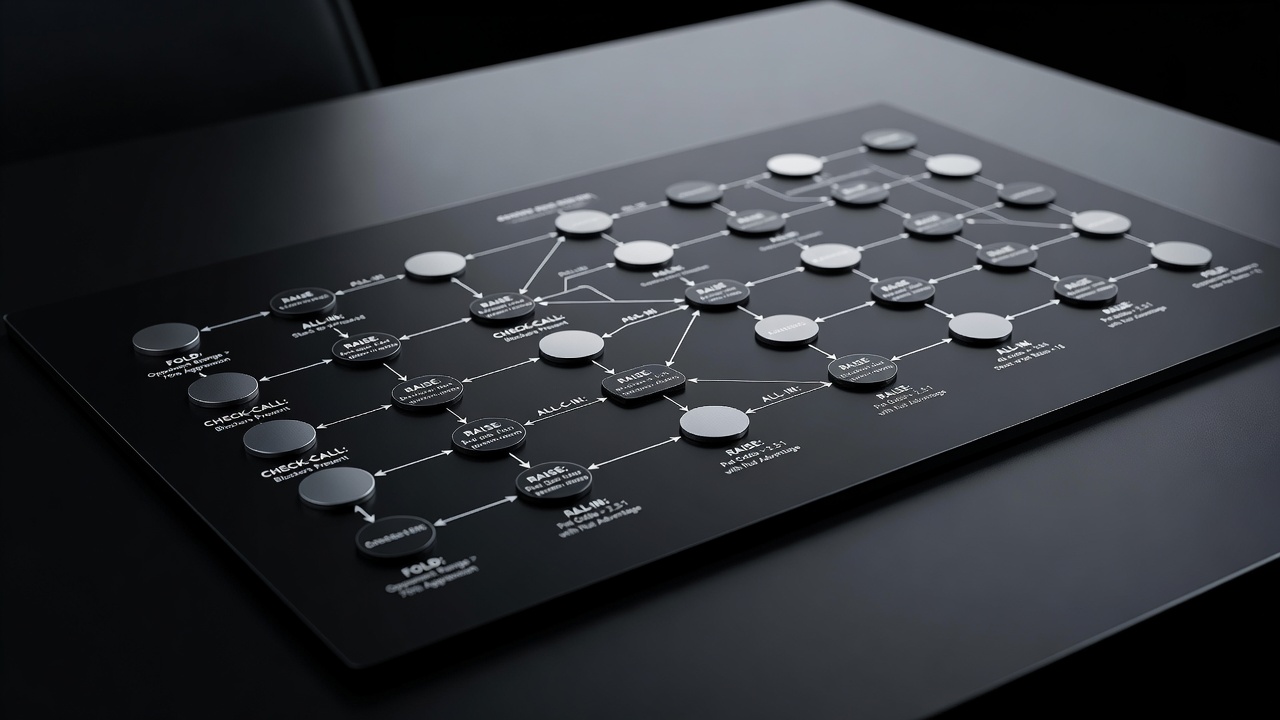
The year was 2014. Phil Ivey was at the tables, Vanessa Selbst was dominating, Daniel Negreanu was still at the peak of his powers. None of them had access to what a decent online grinder has today: a solver. PioSOLVER launched in beta that year. Monker Solver came later. By 2018, even mid-stakes cash players were running daily postmortem sessions against their own Nash equilibrium.
This changed everything. Before solvers, poker theory was experiential. You played thousands of hands, learned by osmosis, got crushed until you didn't. The pros had a five-to-ten-year edge. Now, a hungry 22-year-old on a MacBook can download PioSOLVER, set up a specific scenario (stacks, positions, ranges, stack-to-pot ratios), and see exactly what equilibrium strategy looks like. Not approximately. Exactly.
GTO stands for Game Theory Optimal. The basic idea: it's a strategy so balanced that an opponent playing optimally cannot exploit it. If you're playing GTO in a specific spot, and your opponent deviates, you benefit. If they play GTO too, neither of you makes money on that hand (in expectation; variance still crushes). For cash game players, GTO is a defensive foundation. You build on it. For tournament players, especially at the top of the structure where ICM (Independent Chip Model) pressure becomes relevant, GTO is closer to a ceiling.
What Changed
Before solvers, poker strategy was dominated by old-school heuristics: "play tight in early position," "you need a hand to bluff," "fold to aggression." These rules worked because most opponents were exploitable; they folded too much or called too much. A smart player could spot the leak and print money by exploiting it. The people making the most at the tables were the ones who best understood which opponents were tilted, scared, bored, or running over the whole table.
Solvers flipped the orientation. They showed that the optimal strategy in a specific situation (button push-fold at 20BB, for example) is not "play tight": it's a precise mix. Button pushes 60% of hands. Big blind calls with a tighter range than pure GTO (exploitatively, because they know button is trying to print chips). If button adjusts and opens only 40% of hands, big blind's exploitation breaks down.
This didn't make poker less skill-based. It made it more mathematical. The players crushing now are the ones who can both know the solved lines and read when an opponent is deviating from them. Names like Linus Loeliger, Fedor Holz, and Dustin Hoffman (yes, another Hoffman; poker is full of them) came up in the solver era. They don't win because solvers told them the answer; they win because they learned to use solvers to build a foundation, then play against the exploitable patterns in real humans.
RunIT Twice Poker Academy released preflop charts that were roughly solver-validated. Jonathan Little wrote a book. Upswing Poker launched a whole curriculum. The information democratized. But the translation from theory to live tables still requires judgment. A solver can tell you that 22 is a profitable 3-bet in the small blind versus a wide cutoff opener. It cannot tell you that the cutoff is tilted, just won a 50BB pot, and will call your 3-bet with 85o because he's steaming.
The players winning the most are not the ones who follow solvers most faithfully. They are the ones who know when to deviate from solvers because they read their opponents better.
Cash game players use solvers differently than tournament players. In cash, you're trying to identify leaks in your exploitable opponents and maximize EV against them. You solve spots to build an intuitive sense of what "standard" looks like, then you deliberately deviate. In tournaments, especially deep-stacked early-tournament play, you're building a balanced range so you don't get exploited hard and busted. Push-fold charts for 8BB and below are nearly 100% solved; every tournament player memorizes them or should.
The modern grinder's workflow is a mix: solve the problem on PioSOLVER, build intuition about balanced ranges, run tournament simulations to see how hands perform across 1000 iterations, then translate that into a feel for your live table. It's technical, mathematical work that happens between sessions. At the table, it's the same as it always was: read the player, understand what they're holding, figure out what they think you're holding, and make them fold or make value. The solver gave you a cheat sheet. You still have to know when to use it.
New players should not start with solvers. They should learn fundamentals: position, hand strength, pot odds, aggression. After a few hundred hours of study and play, a solver becomes useful as a tool for confirming intuitions and plugging holes. It's not a replacement for thinking. It's a magnifying glass held over the parts where you're uncertain.